

what 'one battle after another' gets right about central valley fashion
guest contributor natalia gevara breaks down the onscreen wardrobe that feels like home.

Last November, the elimination of Teen Vogue as a standalone outlet marked a huge loss for youth-driven, politically-engaged journalism. As I saw the writers getting laid off and sharing “end of an era” posts online, I thought to myself…I would love to bring a piece of the Teen Vogue ethos to the Molehill in some way. We share a similar perspective—that fashion does not exist in a vacuum—so it felt like an organic fit.
So, let me introduce today’s guest contributor!
Natalia Gevara is a writer hailing from the San Joaquin Valley of California. She has written for Teen Vogue about Central Valley activists fighting against ICE raids, and is currently based in New York City.
As One Battle After Another is expected to win awards at this Sunday’s Golden Globes, Natalia’s article offers a timely lens for examining how film, fashion, and politics intersect.
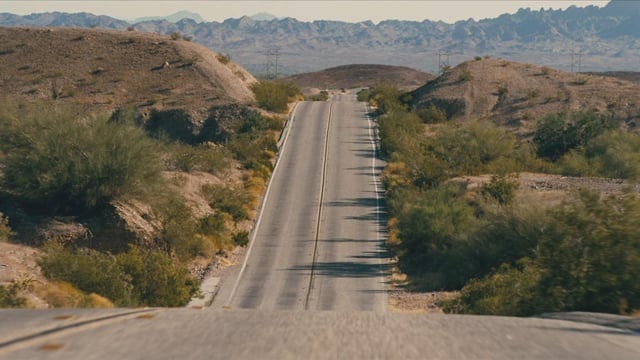
This awards season, I’m reflecting on the most impactful pieces of media—and Paul Thomas Anderson’s action thriller One Battle After Another (OBAA) definitely makes the list.
Leonardo DiCaprio plays Bob Ferguson, a jaded ex-revolutionary who is forced back into his old lifestyle when he and his teenage daughter Willa (Chase Infiniti) are pursued by a white supremacist military officer.
There are a number of things that I love about this film: the heartwarming relationship between a father and daughter, the engrossing performances of an all-star cast, a riveting score that amplifies every scene—and the costuming. Colleen Atwood, the film’s costume designer, told Vogue that the costumes were “firmly planted in reality.” What struck me about Atwood’s work was the subtle yet precise character portrayal through clothing.
OBAA was filmed in parts of Northern California—specifically in my hometown of Stockton, located in the Central Valley.
There’s a strong sense of local pride here stemming from a long history of immigration. Throughout the 20th century, waves of migrants from Mexico, India, Vietnam, China, Cambodia, Laos, Palestine, and the Philippines settled in the Central Valley, primarily to work in agriculture. With the country’s skyrocketing anti-immigrant sentiment these past couple of years, fashion has been an ever-present mode of community resistance.
So, watching the film as a Central Valley native, I couldn’t help but notice the ways the costume design reflected this sartorial reality.
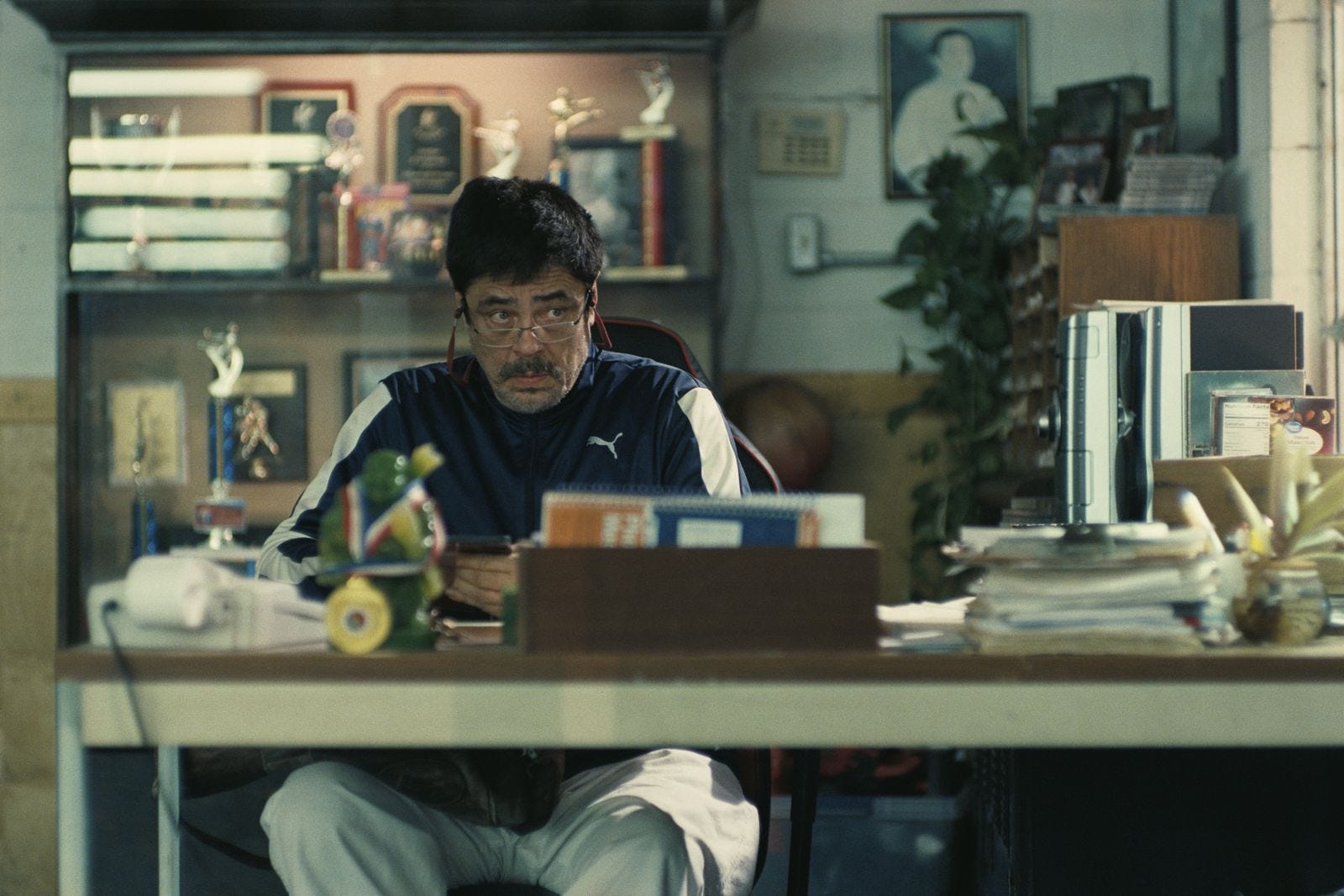
The street style here is a means of holding onto our culture. For example, sportswear is popular, reflecting the impact of Black culture on the Northern California fashion scene. Even Sensei Sergio (Benicio Del Toro) was rocking a Puma jacket and Adidas slides with his martial arts gi pants, a very nice touch.
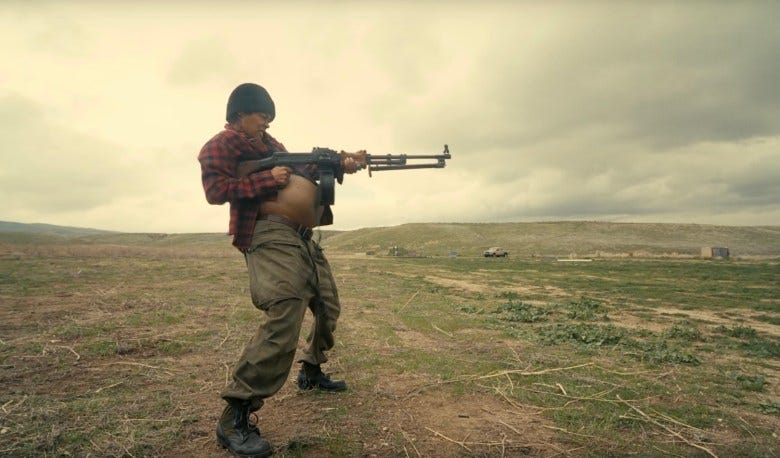
Button-ups (to the TOP) and flannels are also a decades-long closet staple that fall under the broader umbrella of the cholo/a subculture birthed by the Chicano movement.
In one of the film’s most memorable scenes, revolutionary leader Perfidia Beverly Hills (Teyana Taylor) shoots an automatic rifle in a red and black checked flannel, military green cargo pants, combat boots, and a bulging baby bump.
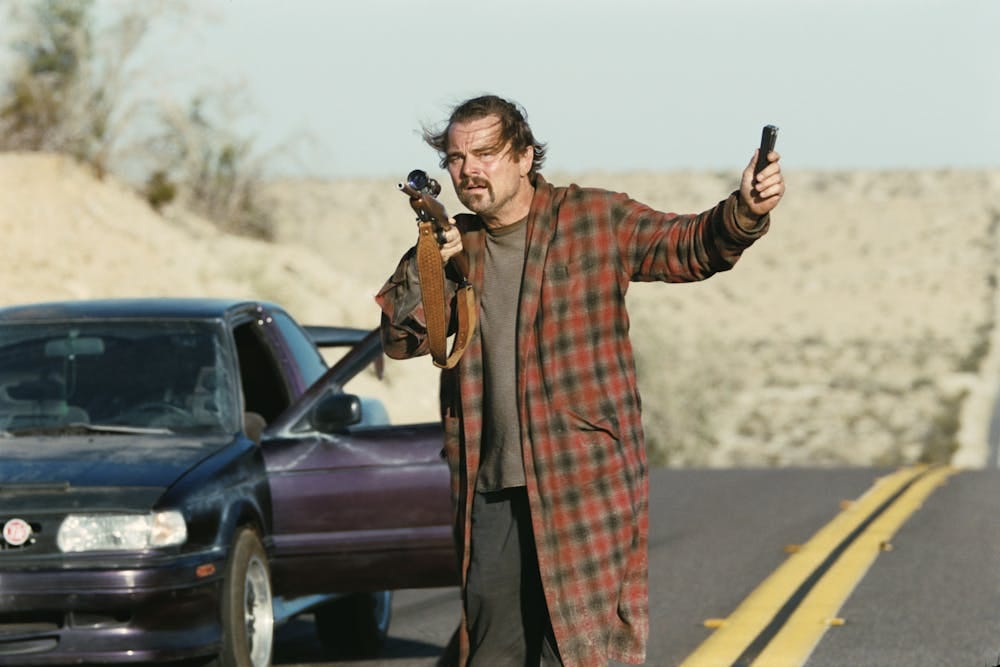
The color and pattern of Perfidia’s flannel is echoed later in the film through Bob’s house robe, mirroring how he is continuing her legacy through protecting their daughter.
Let’s zoom out to examine how community groups are dressed.
The vato skateboarders in Sensei Sergio’s alliance are actual skateboarders from El Paso, Texas who were cast to play themselves. Like cholos, Latino skateboarders are another subculture with a profound impact on Central Valley fashion. When I was watching this scene in theaters, all I could think about was how much they reminded me of my younger brother and other Latino skaters in Stockton.
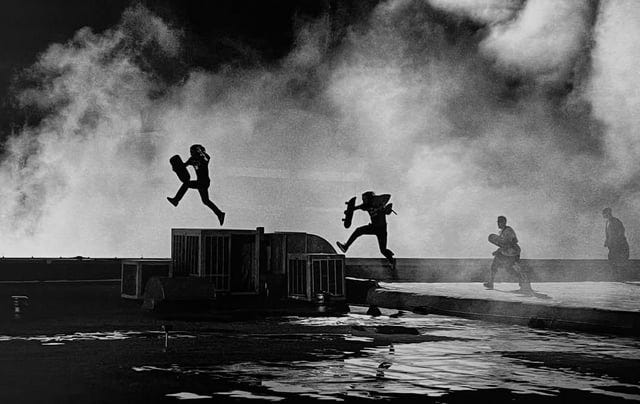
The Central Valley epitomizes cultural amalgamation. These garments reflect how we’ve integrated into the United States without being homogenized—honoring our roots and political identities through what we wear. Additionally, our fashion choices don’t just signify who we are, but who we aren’t.
This idea is explored in the protestors vs. police face-off scene.
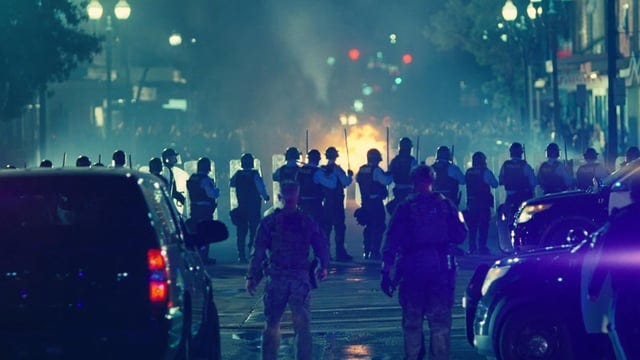
The film’s fascist villain Colonel Lockjaw invades Bob and Willa’s community with a slew of military men at his command. In these scenes, it is obvious who the enemy is because they are homogeneously outfitted in army uniforms.
The community stands in protest against these interlopers, but they are quickly infiltrated by a military man disguised in an outfit similar to that of the vato skaters—a black graphic t-shirt, backwards hat, and black balaclava. In this disguise, the infiltrator disrupts the community’s attempts at resistance by throwing a molotov cocktail from their side of the protest to that of the military police. This enables the police to escalate violence against the protestors.
In this instance, fashion is utilized as a political weapon. In the Central Valley, it is one that we wield in our everyday lives in the face of ICE raids. I believe this is what Atwood and PTA were aiming to convey through their costuming choices, underscoring how diverse self-expression is an antidote to fascist homogenization.
You have one side, the military and police primarily composed of white men in uniforms, versus a diverse community who display their resistance by protecting their neighbors and wearing clothing that honors their roots. These scenes are effective, because they mirror the ones occurring in the Central Valley.
One Battle After Another will remain one of my favorite films of 2025, because every little detail—especially the costuming—hits extremely close to home.
Thanks for reading.
Your paid subscription allows me to bring on guest writers and compensate them for their hard work and unique point of view!
xo viv


As a Central Valley babe, I haven’t wanted to watch OBAA until this post!! I must check it out now
I was relieved to find that el paso culture was represented very well in this film! It was refreshing to see real people from my city getting screen time and that they scouted from the community :’) it totally contributed to the cohesive vibe of the film!